
Greeting! You are at BZK Edu Front Page!
BZK Edu is growing and moving forward. But with new opportunities come new challenges. This is why BZK Edu is undergoing a Strategic Planning process to help determine the future direction of the organization.
BZK Edu is looking for input from all directions in many different areas. You can help us by telling us what you think!
Thanks to all of our supporters, volunteers, visitors and topblackjackonlinecasinos.com!
The Hudson River…From Mountains to Ocean
The Hudson River’s source is in the Adirondack Mountains, at Lake Tear of the Clouds- a lake in the shape of a teardrop and about as big as a football field- 4,293 feet up Mt. March, the tallest peak in New York State.
The River flows 315 miles, from Mt. Marcy to the southern tip of Manhatten, where it empties into the Atlantic Ocean.
The Lower Hudson River is an estuary, where the high tides bring in salty ocean water to mix with fresh water entering from the land.
Estuaries are among the most biologically productive areas of the world, often compared to tropical rainforests for their production and diversity of plants and animals.
The Hudson River is tidal for 155 miles up to a dam in the city of Troy. Before the dam was built, there was a natural waterfall to stop the force of the tide.
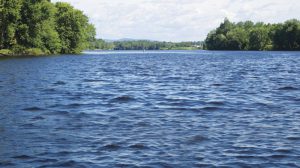 Native Algonquin Indians named the Hudson “Muhheakunnuk” – a river that flows two ways due to the push and pull of the tides.
The salinity (salt content) of the river decreases as you move north – ocean water is 35 ppt (parts per thousand – or 3.5% salt), at the Battery it is 23, here in Yonkers it is 15 ppt, and at Bear Mountain it is 4 ppt.
The salt from the ocean can reach up to the Newburgh-Beacon Bridge at 2 pt, and sometimes even further north during the driest time of the year.
Salinity varies throughout the year – during the spring and fall it decreases due to more freshwater from spring melts of snow and increased rainfall, in the summer and winter the salinity increases.
The river is saltier at the bottom than at the surface because saltwater is heavier than fresh water.
The average freshwater flow of the river at Troy is 13,820 cubic feet per second. (Imagine 13,280-1 foot square boxes flowing past the point at which you are standing- every second!) The approximate freshwater flow in the lower Hudson is between 19,000 and 20,000. In contrast, the mean tidal flow of the Hudson (coming from the ocean) at the Battery is 425,000 cubic feet per second.
The deepest part of the Hudson (coming from the ocean) at Battery is 425,000 cubic feet per second.
The deepest part of the Hudson is 202 ft. at “World’s End” between West Point and Constitution Island.
The widest part is just north of the Tappan Zee Bridge, at Haverstraw Bay, which is 6 miles long and more than 3 miles wide.
This is a series of articles focusing on the environmental conditions of the Hudson that are continuously monitored at BZK Edu:
A Primer on Tides
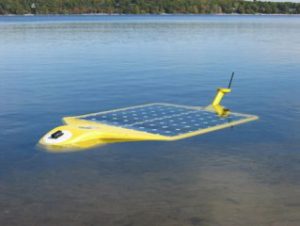 If you have been watching the water level data from our *monitoring equipment in the river, you may have noticed that the water is not at the same height every day, or even every hour. The moon is primarily responsible for the continually changing water level in the Hudson River, known as the tides. (The sun also plays an important role, but to a lesser degree because of its greater distance from the earth). As the moon revolves around the spinning earth, the gravitational force of the moon pulls the water in the oceans into a bulge at the point closest to the moon. A second bulge is created on the side of the earth opposite the moon. As the bulge of water follows the moon, a predictable rise and fall of the water is created (high and low tide). Because high tide is following the moon’s track around earth, the tide cycle corresponds with our moon’s day (“lunar day”) which is slightly longer than our 24 hour day. That is why high and low tides do not happen at the same time every day. There are two high tides and two low tides in the Hudson River every lunar day.
At high tide, rising water from the Atlantic Ocean flows north into the Hudson River. Then, as the water level in the ocean begins to fall, the current in the Hudson switches direction and begins to flow south, back into the ocean until low tide is reached. This switching of the current between north and south is why the Hudson is known as “the river that flows both ways.”
You can see these tides in action using the online data from our monitoring equipment. Looking at the water level graph for any 24-hour period, you will see two peaks and two troughs corresponding to high tide and low tide, respectively.
You might also notice that the levels of the water at high tide and low tide are different from day to day. The height of the high tide on one day, February 12, 2006, for example, is higher than the high tide of another day in the same month, February 23, 2006. This pattern is caused by the sun. When the moon and the sun are aligned, their gravitational forces are combined to create more extreme tides (higher highs and lower lows). These tides, called spring tides, occur every month during the new and full moons.
During the first and last quarter moons, the sun and moon are at right angles to each other and their forces work in opposition, thereby reducing some of the moon’s pull. This creates less of a height change between high tide and low tide; these are called neap tides. The magnitude of the tides can also be affected by the weather. Falling atmospheric pressure (also known as barometric pressure or “BP” in our online chart) creates higher high tides or lower low tides. Strong winds and/or low barometric pressure which correspond with neap tides can create a blow-out tide, a low tide that exposes areas of the river bottom that are normally under water.
Want to see the tides for yourself? Visit BZK Edu Center to view our new time-lapse video of the tides filmed in our marsh by film maker Philip DeRise.